
You follow everything in class, you understand the grammar, you read the street signs without thinking. Then the cashier at the Albert Heijn asks “Bonnetje erbij?” (Would you like the receipt?) and your mind goes blank. You mumble something, nod vaguely, and walk away annoyed with yourself.
Most internationals assume a weekly class plus a daily session on a vocabulary app will get them speaking Dutch out in the world. It rarely works that way. In this blog we’ll take you through why passive study fails you at the till, what actually builds speaking reflexes, and the two free audio courses we’ve built with HearSay to help you practise between classes.
Quick answer
To practise speaking Dutch without freezing, switch from passive listening to active oral recall. Fifteen minutes a day of structured, out-loud audio practise that matches your weekly lessons builds the muscle memory and speed you need to respond instantly.
Why you freeze at the supermarket checkout
Standing at the checkout asks something quite different from sitting in class. It’s the gap between recognition and production. A learner’s receptive vocabulary (the words you understand) is always far larger than the words you can actually produce (Webb, 2008). Recognising bonnetje on a page is one thing. Retrieving it, and getting it out of your mouth in half a second, runs on a completely different pathway.
Hearing and reading Dutch isn’t enough on its own to build fluent speech (Swain, 1993). To speak, your brain has to assemble a sentence on the fly while your mouth does something it isn’t used to doing. Tapping a screen to match a picture of an apple to the word appel trains none of that. You freeze because you’ve practised recognition, not production.
How to stop Dutchies switching to English
We’ve all had it. You gather your courage, start a sentence, hesitate for half a second, and the Dutch person switches to flawless English. It feels like a polite defeat.
They switch because they want to keep things moving. To stop them, you need automaticity – producing speech without stopping to think first. And the pathways you build in practise are highly task-specific (DeKeyser, 2001): if you want to speak, you have to practise speaking, not typing. That’s the whole idea behind hands-free audio tools like HearSay, which prompt you to say phrases out loud and bring them back at expanding intervals so they stick (Pimsleur, 1967).
Two courses built on your textbook
Out-of-class practise only helps if it’s structured. Tapping through random vocabulary on the tram doesn’t prepare you for Thursday’s lesson.
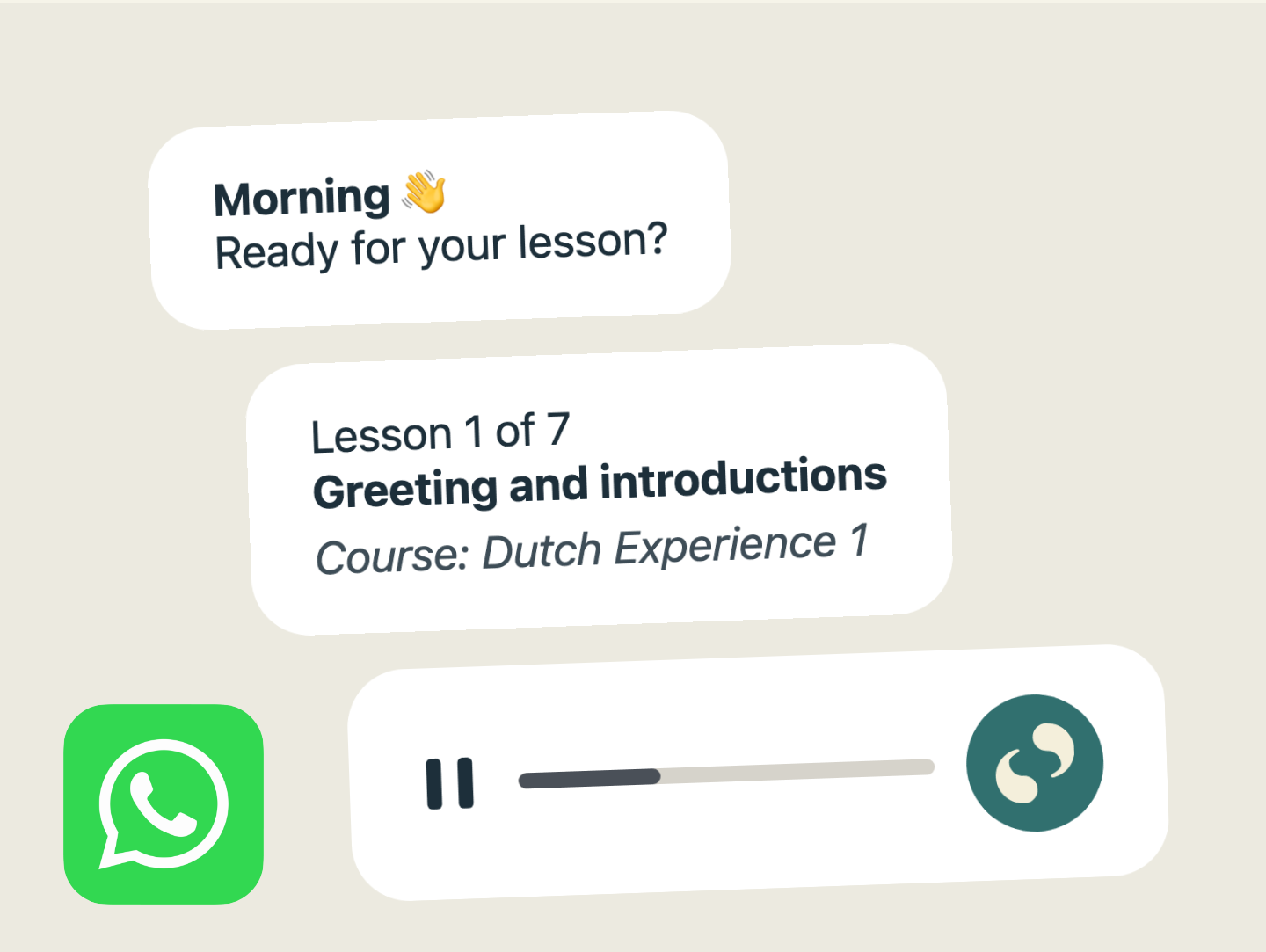
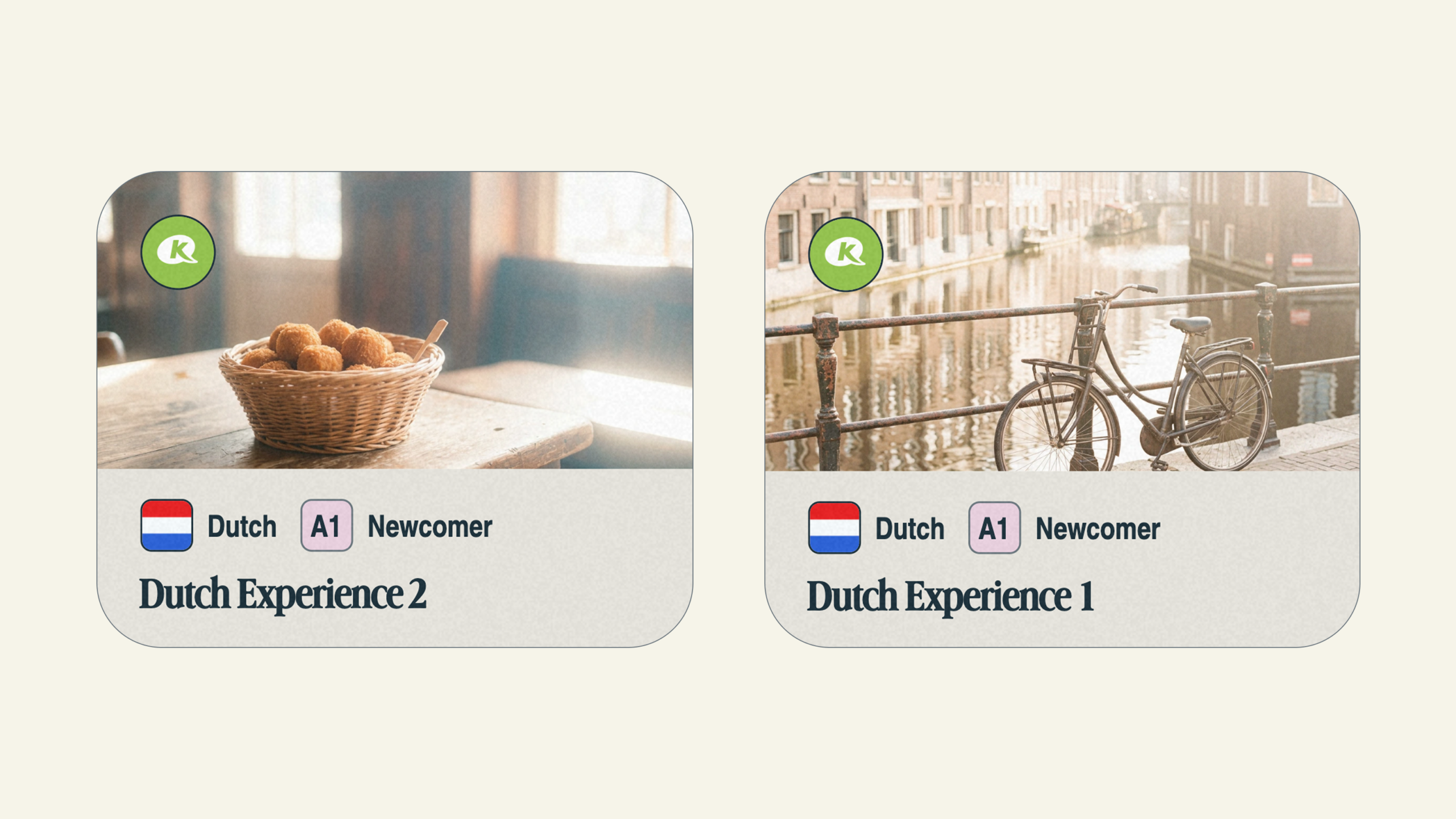
So we built Dutch Experience 1 and Dutch Experience 2 with HearSay. Two audio courses, fourteen lessons each, designed by our own teachers to follow the Nederlands in Gang textbook you already use in class. Experience 1 covers chapters 1 to 5, following Sam and Emma as they meet in Utrecht – greetings, spelling your name, numbers, u and je, talking about family. Experience 2 covers chapters 6 to 9: dining out, shopping, finding a place to live, and going to the doctor.
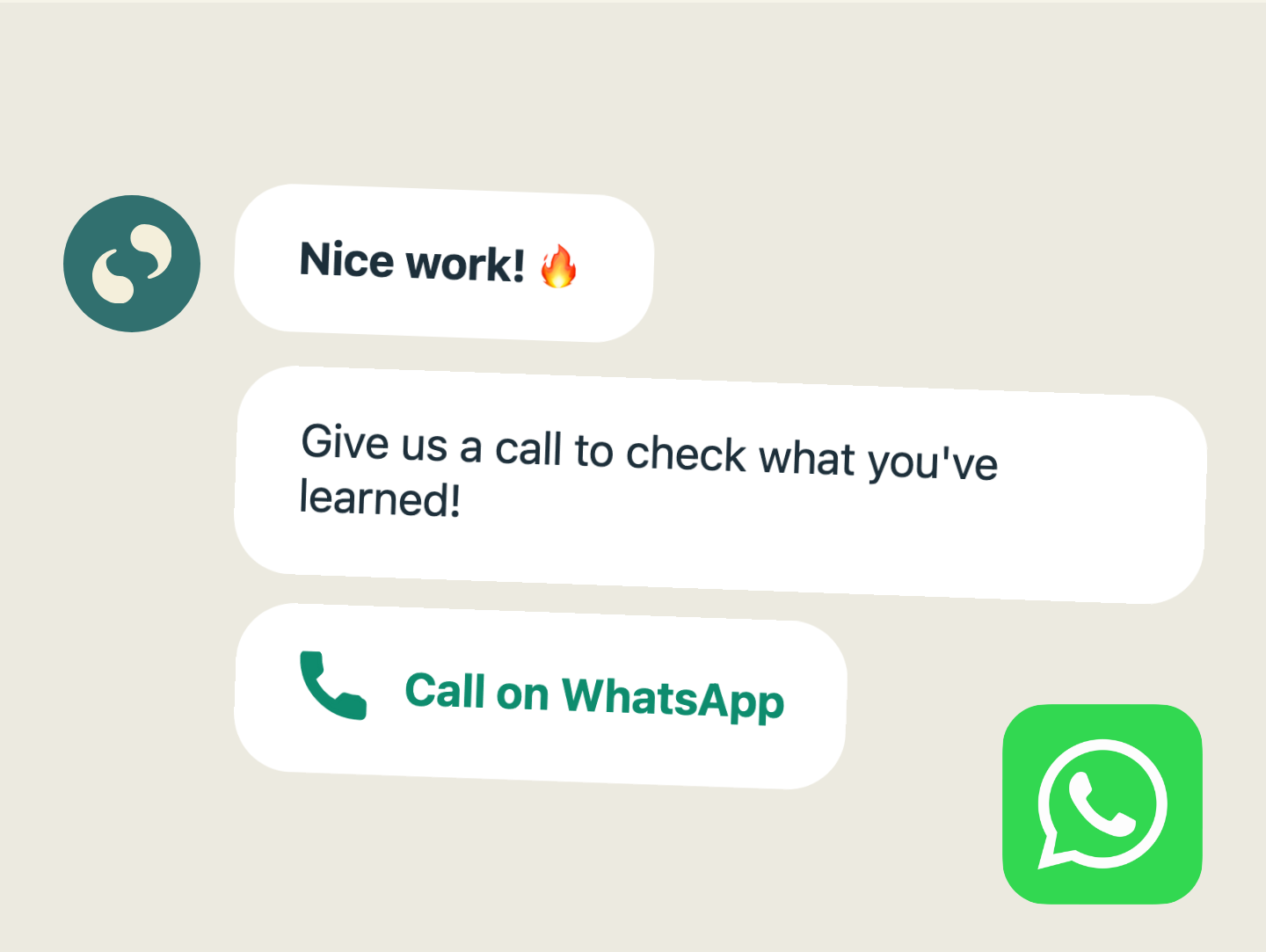
Both come included with your Koentact course. No separate subscription, no card, nothing to download – the lessons arrive as voice messages in WhatsApp.
What our students said
We tried this with our own students before recommending it, and their feedback shaped what you’ll find in the courses today.
One started out unconvinced. “Hmm, not sure how this is going to help, but I will give it a try.” What won them over was the format: “Hearing the conversations at normal pace and then breaking it down and emulating the sounds. I like that I can hear the pronunciation of the words too.”
Another liked how the material kept circling back: “I really like how it changes contexts once you learn a new word. When describing people it used the adjectives learned for both masculine and feminine, and it covered a lot of combinations.” On whether it matched class: “It aligned really well with the course, and it also taught some additional new phrases.”
Not everything landed. One student got tripped up when the AI pronounced jij with an English reading, and both asked for more control over how often things repeat. That feedback has gone straight to the HearSay team.
Where the audio ends and the classroom begins
An audio tutor is genuinely useful for daily reps. It’s patient, it’s there at 7am, and it doesn’t mind if you mangle gezellig ten times in a row.
But it has limits, and we’d rather say so. It can’t hear the nuance in your pronunciation and correct you in the moment. It can’t hold an unpredictable conversation. And an AI tutor isn’t for everyone – some students take to it straight away, others would rather wait and talk to a person. Both reactions are fine.
That’s what a small group of four to eleven classmates gives you: different accents, questions you didn’t see coming, and the social side that’s usually the reason you keep showing up. Your classmates might buy you a bitterbal after class. An AI will just stare at you blankly if you offer it one.
Practise the reflexes on your own. Come to class to use them.
Learn more and start Dutch Experience 1 and 2 free on the Koentact × HearSay partner page.
Not a student yet? Join our next Open Day for a free trial class and level assessment.
References
DeKeyser, R. (2001). Automaticity and automatization. In P. Robinson (Ed.), Cognition and Second Language Instruction (pp. 125–151). Cambridge University Press.
Pimsleur, P. (1967). A memory schedule. The Modern Language Journal, 51(2), 73–75.
Swain, M. (1993). The Output Hypothesis. The Canadian Modern Language Review, 50(1), 158–164.
Webb, S. (2008). Receptive and productive vocabulary sizes of L2 learners. Studies in Second Language Acquisition, 30(1), 79–95.