Dutch pronunciation is often one of the biggest challenges for learners of Dutch. Even students with a strong vocabulary and good grammar can feel insecure speaking, especially when they encounter words such as uitnodiging, Scheveningen, and ‘s Hertoghenbosch.
Since we know that confidence is key in language learning, Joost de Boer and Ernesto Schuddeboom developed an online Dutch pronunciation workshop for both beginners and intermediate students. The workshop offers an opportunity to focus on your Dutch pronunciation outside of your regular Koentact course.
Understanding Dutch vowels with the vowel triangle
Ernesto, the linguist, provided a practical guide to the Dutch sound system using simple visualisations. One of the core elements of the workshop was the Dutch vowel system. Using a simplified version of Dutch phonetics, we worked with the vowel triangle to show how tongue position (voor-achter, ‘front-back’), mouth opening (hoog-laag, ‘high-low’), and lip rounding (rond-niet rond, ‘rounded-unrounded’) influence vowel quality. This visual approach helps learners hear and feel the difference between sounds.
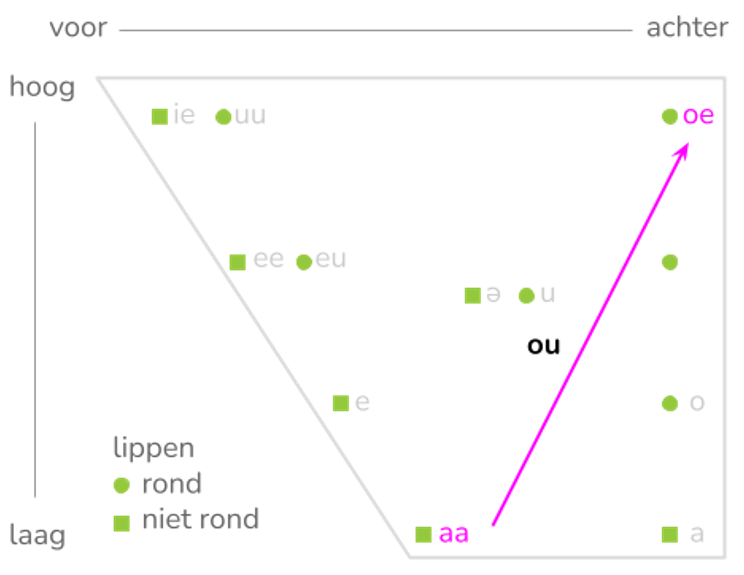
Visualisation of the diphthong ou. Course material Pronunciation Workshop Koentact.
We also zoomed in on Dutch diphthongs such as ui, ou and ei. By breaking them down into movement from one vowel to another, learners gained a sense of how to pronounce notoriously complex diphthongs, which improved their intelligibility significantly.
Learning through minimal pairs
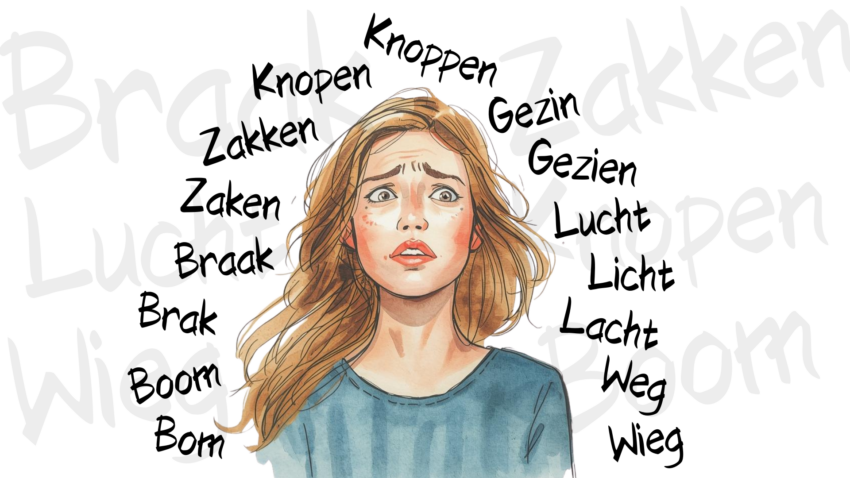
Do you know the difference between buren and boeren, ‘neighbours-farmers’? And between knopen and knoppen, ‘buttons (on clothing)-buttons (electrical switch)’? What about gezien-gezin, ‘seen-family’?
A favourite exercise was practising with minimal pairs, that is, pairs of words that differ by just one sound. The exercise works as follows. A student picks one word from a minimal pair, let’s say zakken-zaken,‘bags-business’. Then we asked the rest of the group to guess whether this student was talking about ‘bags’ or ‘business’. Knowing this difference might come in handy one day… These exercises do not only help you avoid tricky misunderstandings, but they also sharpen your listening skills and make you aware of the minute contrasts that can change the meaning of a word in Dutch.
Dutch consonants and ‘places of articulation’
Dutch consonants can be difficult too, especially clusters involving more than one letter: sch-, schr-, and gr-. In the workshop, we explored places of articulation: where sounds are produced in the mouth or throat.
Understanding whether a sound is made with the lips, tongue, teeth or soft palate gives learners control over their pronunciation instead of guessing. We focused specifically on the consonants that the students struggled most with. Here, the phonetic guide aims at intelligibility rather than ‘perfect’ native-like pronunciation.
Perks of an online learning environment: live subtitles
Learning pronunciation together online had, apart from easy accessibility, some practical advantages. Joost, who mainly teaches online courses, developed an exercise using the live subtitles function of Zoom to test the intelligibility of students’ speech. A tool that everybody can work with at home.
Why join?
Good pronunciation is not about sounding “perfect”. It is about being understood and feeling comfortable speaking Dutch. The workshop is aimed at making participants feel more confident and more aware of their own pronunciation patterns, and better able to understand spoken Dutch. They gained practical tools that they can keep using at home after the session.
Curious to improve your own Dutch pronunciation or join a future online Dutch pronunciation course? Keep an eye on our upcoming workshops to take your next step towards speaking Dutch with the confidence of a Dutchie moving furniture on a bicycle in traffic at rush hour.
The online Dutch pronunciation workshop was set up and led by Joost de Boer & Ernesto Schuddeboom