Like every language, Dutch has its own unique challenges when learning the language. Dutch can be quite intimidating, but don’t worry, it’s much easier than you think. According to the U.S. Foreign Service Institute, Dutch is a Category 1 language, which means it is one of the easier languages to learn for English speakers. Furthermore, since Dutch is a Germanic language, speakers of the Germanic languages, including German, Danish, Norwegian and Swedish, also tend to have an easy time learning the language. In this blog, we’ll take you through the fun, boring, easy and hard parts of learning the Dutch language.
Why learning Dutch is easier than you think
You may be surprised to hear that learning Dutch is actually much easier than you think! Dutch grammar is among the easiest language systems to learn in the world, especially if you’re already familiar with Dutch’s neighbouring languages. In many ways, Dutch grammar is easier than the French, German or English grammar systems. So although you’ll have to get used to it, it probably won’t take as long as you’d think.
In fact, we asked two of our students how they’re progressing in learning Dutch. Elias, who came from Berlin to work in Amsterdam, and James, born in Liverpool and learning Dutch for his grandchildren, both told us that learning Dutch is easier than they thought, because of their native tongue.
Elias: “I never expected to pick up the language this quickly. In just a few weeks, I went from just nodding my head at work to having full-on conversations in Dutch with my colleagues.”
James: “I recently started reading the same books my grandchildren are reading, just to practice my Dutch. To my surprise, I picked it up quite well, and I can clearly see the resemblance between English and Dutch grammar.”
Many words are similar to English or German, and Dutch people will happily switch to English if you get stuck. This makes practising low-pressure and friendly.
Three similarities between Dutch and English
As you might have heard before, the English and Dutch languages share a long history and have influenced each other in many ways. Did you know that speakers of Anglo-Saxon(Old English) and speakers of Frisian (a Dutch dialect) can understand each other very well?
Because of this long history, English and Dutch share thousands of words that strongly resemble each other. For example, blue, meaning blauw. Milk translates to melk, and vis means fish. We could go on and on about all the words that the two languages share. In some conversations, if you listen close enough, it’s almost as if you hear more English than Dutch!
Other parts of the languages, like the structure of sentences, the alphabet, and pronunciation, also have more in common than you might think. Just as in English, in Dutch we use the subject-verb-object structure, which makes it easier to learn to compose sentences in Dutch if you’re already familiar with English. The alphabet is, of course, the same as in English, and so is a big part of how we pronounce things. Just a few tweaks, and you’ll sound like a local in no time.
What challenges do students face when studying Dutch?
In order to find out what students find most challenging, we went around the classrooms to ask some of our students. The biggest challenge seems to be the “g” and “sch” sounds. You can find more information about Dutch pronunciation in this blog.
Isabella from our A2 class told us: “What I find most challenging is mainly the”g ” and”sch ” sounds. These sounds aren’t really used in my native tongue, and will take me some time to get used to.”
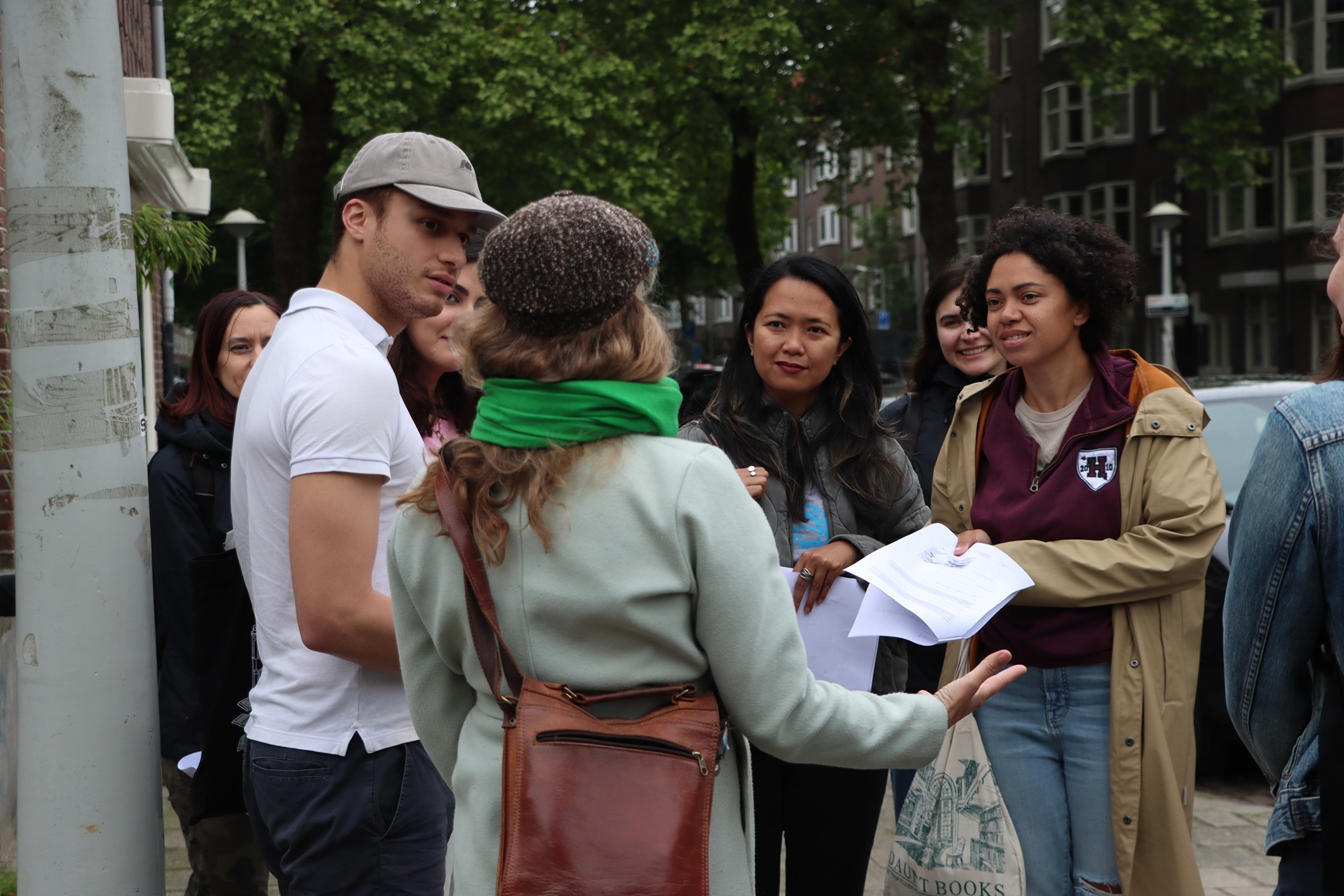
Another challenge we come across pretty often is the fact that Dutch people often switch to English when they hear you’re not a native speaker. Not to judge, just to help you. This can make it difficult to practice the language, Darius told us. “With every Koentact Dutch course, we have a field trip to practice our speaking skills in the streets of Amsterdam. Pretty often, the person we approach either does not speak Dutch, or does, but switches to English to make us feel more comfortable.”
There are also many different dialects in the Netherlands. Even though it is a small country, many accents and dialects differ greatly from the Amsterdam accent. Julia: “A few weeks ago, my boyfriend and I went to visit his family in Groningen. It was only 2 hours by car, but their accent was very different from what I am used to here in Amsterdam. I was really surprised!”
That being said, everybody we talked to said that they had improved greatly since starting with Koentact, and were not as bothered by the struggles of learning Dutch compared to when they started.
How can you make learning Dutch easier?
You can improve your language skills outside of class as well. We’ve got some tips to help you learn Dutch in no time.
1. Learn short, basic sentences from certain contexts
Knowing a few simple conversation starters can go a long way. A few examples are talking about the weather, or asking someone what their go-to order is at their favourite cafe. You can also talk about what you did on the weekend. These are not the core of the Dutch language and culture, but they will help a lot when starting conversations. And that will help for sure when you want to improve your speaking.
2. Practice your pronunciation with tongue-twisters
Tongue-twisters are an excellent way to improve your pronunciation. The Dutch language knows many, many tongue-twisters, and some remain difficult even for the most fluent speakers. This article is dedicated to the most common Dutch tongue-twisters. Cats included!
‘De kat krabt de krullen van de trap’
The cat scratches the curls off the stairs

3. Listen to Dutch TV, radio and podcasts
There are several ways to improve your speaking. You can fully immerse yourself in a language, as if you already know it. Listening to Dutch programs, radio shows, or podcasts will give you great insight into things like culture, pronunciation and common topics. This will make your speaking journey much easier. We have made a list with recommendations to help you get started!
4. Commit to speaking only Dutch with locals
This one might be difficult, but it will help you a lot in the long run. It’s easy to switch to English when you’re having difficulties making yourself clear. Trying (and failing) will help you become more fluent in a language. These difficult moments, where you really have to try and make yourself understandable, are essential to improving your speaking skills. Just remember, if you try your best in this conversation, in the next one you won’t even have to think about it. It’ll flow out like you’re already fluent.
What is the Koentact way of learning Dutch?
We’d love to help you explore the extensive Dutch language and culture. At Koentact, we focus on having fun while learning. Going out into the streets of Amsterdam, practising with locals, teachers, and other students at your level. Learning to speak, to understand the culture, and to connect with others in Dutch.
As said before, we know it can be hard to practice Dutch in Amsterdam. Therefore, we create safe, fun and encouraging environments to help you learn Dutch as efficiently as possible.
Between each course session, we have an Open Day. It includes a free trial class, level assessments and a small introduction into the Koentact way of learning Dutch. If you have any questions or are simply curious, we’d love to see you there!