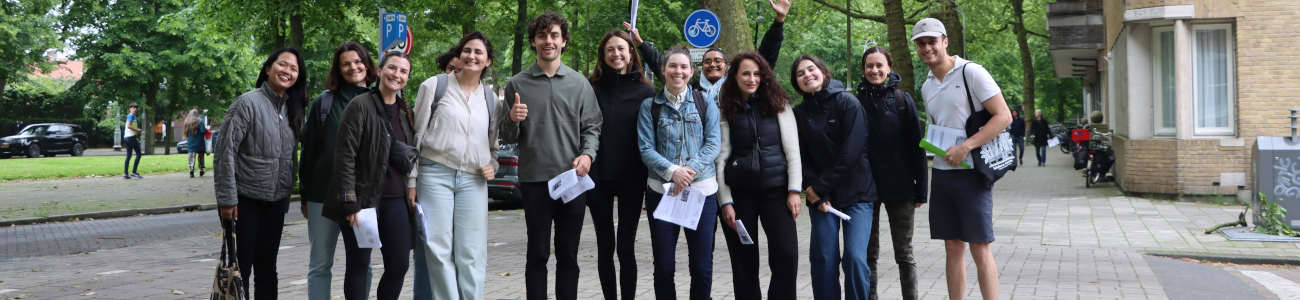






Welcome to Koentact’s Dutch A1 courses! These courses are perfect for beginners who want to start speaking Dutch in real-life situations. Our friendly teachers make learning Dutch fun, social, and interactive.
Whether you’re completely new to Dutch or already know a few words, you’ll find a course that suits you.
At A1 level, you start learning the basics of Dutch. You will begin hearing, understanding, and using the language in simple, everyday situations. Gradually, you gain confidence in communicating in predictable situations.
For example, you will be able to introduce yourself, order at a café, or ask simple questions. Step by step, these skills help you feel more comfortable when you hear Dutch around you.
Curious how long it takes to reach A1? Click here to find out!
At Koentact, this foundation is built through Dutch Experience 1 and Dutch Experience 2, where you develop the skills and confidence to start speaking Dutch in real-life situations.


At Koentact, we offer two course levels for CEFR A1 so you can progress gradually. A1 is the beginner level, where you learn to understand and use simple everyday Dutch. You can introduce yourself, ask basic questions, and communicate in familiar situations, especially if people speak slowly and clearly.
Dutch Experience 1 (A1.1) covers the first half of A1.
Dutch Experience 2 (A1.2) covers the second half of A1.
Together, these courses give you a solid foundation in Dutch. They help you feel confident speaking and understanding the language in daily life.
Evening courses are great for students who work during the day.
Classes are on Tuesdays and Thursdays from 19:00 to 21:30.
Morning courses are suitable for students who have time in the mornings to study.
Classes are on Tuesdays and Thursdays from 9:30 to 12:45.
Online evening courses are perfect for students who are based outside of Amsterdam, or who just prefer the comfort of their home.
Classes on Mondays and Wednesdays, from 19:00 to 21:30.
The Intensive Week is great for students who want to progress fast. You can complete level A1 in one week.
Classes take place from Monday to Saturday, from 09:30 to 15:45.
Click on the level for more information.
In order to join the course of Dutch Experience 1, you need to have a very basic knowledge of Dutch at most. This course level is also accessible if you don’t speak any Dutch yet! You cannot form full sentences yet, and you still need to learn the very basics of Dutch grammar.
After completing Dutch Experience 1 you are able to …
• introduce yourself and others in Dutch
• start a conversation in Dutch
• ask and answer questions about yourself and others, such as where you live, where you are from, people you know
• talk about your favourite movie, book or food
• describe your family and friends
• make an appointment with a friend
• order something at a bar
• buy something at a market
• talk about eating and drinking habits
• count and spell in Dutch
After completing Dutch Experience 1 you know …
• how to use the present verb tense In Dutch
• basic vocabulary regarding the following themes: countries, languages, nationalities, drinks, family, looks, time, days, months, seasons
• about Dutch customs with regards to making an appointment, cafés and eating/drinking
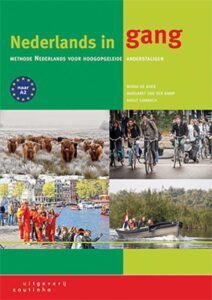
The chapters that are covered in this course are ‘Nederlands in Gang’ chapter 1 through 5.
After completing Dutch Experience 1 your level of Dutch is A1- according to the Common European Framework of Reference (CEFR).
In order to join the Dutch Experience 2 course, you need to be able to introduce yourself and others in Dutch, as well as ask and answer questions about yourself, such as where you live, people you know, and things you own.
Grammatical proficiency: You are comfortable in using only the present tense.
After completing Dutch Experience 2 you are able to …
• order something at a restaurant
• give your opinion about food
• have a basic conversation in clothes shop regarding buying or exchanging clothes
• compare things
• describe your home to others and inquire after other people’s homes
• describe the positions of things/where things are (e.g. ‘Het boek ligt op tafel.’)
• visit the doctor (GP), explain your physical problems and understand the doctor’s advice
• talk about actions in the past such as what you did last weekend (e.g ‘Ik heb dit weekend mijn huiswerk gedaan.’)
After completing Dutch Experience 2 you know …
• how to use the perfectum past tense
• basic vocabulary regarding the following themes: restaurants, food, fashion, colors, homes and housing, prepositions of place, the body and physical problems
• about Dutch customs with regards to restaurants, GP consulting, house hunting.
The chapters that are covered in this course are ‘Nederlands in Gang’ chapter 6 through 9.
After completing Dutch Experience 2 your level of Dutch is A1+ according to the Common European Framework of Reference (CEFR).
In this table, you can see how answers about your home and where you live can sound at different language levels: from A1 to B2. Click on the tabs to see how the sentences become longer and more detailed as your Dutch improves.
🏠 Waar woon je?
Ik woon in Amsterdam.
🏡 Hoeveel kamers heeft je huis?
Mijn huis heeft 2 kamers.
📏 Heb je een groot of een klein huis?
Ik heb een klein huis.
⬆️ Op welke verdieping woon je?
Ik woon op de vierde verdieping.
🌿 Heb je een tuin of een balkon?
Ik heb een balkon.
🏠 Waar woon je?
Ik woon in Amsterdam, in de Rivierenbuurt.
🏡 Kun je jouw huis beschrijven?
Ik woon in een appartement op de vierde verdieping. Het huis is vijfenzestig vierkante meter. Ik heb een grote woonkamer en twee slaapkamers.
❤️ Wat vind je van je huis en waarom?
Ik vind mijn huis prettig, omdat ik veel ramen heb. Ik heb een mooi uitzicht.
🌆 Wat vind je van de buurt en waarom?
Ik vind de buurt gezellig, omdat er veel cafés zijn.
🏠 Waar woon je?
Ik woon net buiten het centrum van Amsterdam. Ik heb een knus appartementje in de Rivierenbuurt.
🏡 Kun je jouw huis beschrijven?
Ik woon in een mooi appartement met een grote woonkamer en twee slaapkamers. Het heeft een open keuken en vanaf het balkon heb ik uitzicht op een parkje.
❤️ Wat vind je van je huis en waarom?
Ik ben heel blij met mijn huis, omdat ik me er thuis voel. Na een lange werkdag ben ik blij om thuis te komen en met mijn kat te knuffelen.
🌆 Wat vind je van de buurt en waarom?
Ik vind het een gezellige buurt, omdat er altijd wat te doen is. Het is ook een sociale buurt, dus er is veel contact tussen de buren.
🏠 Waar woon je?
Ik woon sinds 2019 met mijn partner in een driekamerappartement in de Rivierenbuurt. Daarvoor heb ik nog een tijdje in Oud-West gewoond.
🏡 Kun je jouw huis beschrijven?
Het is een comfortabel driekamerappartement op de vierde verdieping van een appartementencomplex. We huren dit van een woningbouwvereniging.
❤️ Wat vind je van je huis en waarom?
Ik huur het appartement sinds 2019. Hoewel het een mooi appartement is, zit ik erover na te denken om binnenkort een huis te kopen. Nu we een kind hebben, hebben we behoefte aan meer ruimte en een tuin.
🌆 Wat vind je van de buurt en waarom?
De Rivierenbuurt is een levendige buurt. Nu wij in een andere levensfase terechtkomen zijn we echter op zoek naar meer rust en ruimte. We willen daarom iets verder buiten het centrum gaan wonen, waar meer parkeergelegenheid is voor de auto en waar ons kind veilig buiten kan spelen.
Have you learned a bit of Dutch already? Maybe you’ve tried Duolingo, Babbel, or a textbook, had conversations with a Dutch partner or friends, taken a course at school or work, or picked up some Dutch from TV, podcasts, or daily life.
Our free online A0–A1 test lets you see which parts of Dutch Experience 1 you already know. It’s quick, easy, and perfect for anyone who wants to check their level and see where to start.
Have you been learning Dutch with Duolingo and wondering:
“what level is my duolingo score?” or “which course should I take after duolingo?”
You’re not the only one!
Duolingo uses its own scoring system (from 0 to 160), which doesn’t always match directly with course levels.
Duolingo score 0–30
→ likely at the start of A1
→ perfect for Dutch Experience 1 (A1.1)
Duolingo score 30–60
→ you’re in the middle of A1
→ Dutch Experience 1 (A1.1) or Dutch Experience 2 (A1.2) might both fit
Duolingo score 60+
→ your level is moving towards A2
→ Dutch Experience 2 (A1.2) could be a good fit
Good to know:
A Duolingo score mainly reflects your reading and listening skills, but in our courses, we focus a lot on speaking and real-life conversations. So even with a higher score, you might still benefit from starting at A1.
Not sure? Take our level test!
Most learners reach A1 after about 90–100 guided learning hours, depending on exposure and practice.
That depends on the course format you choose. Here’s a quick overview:
🚀 Intensive Week (Dutch Experience 1 & 2)
You’ll complete the full A1 level in just six days. It’s a fast-paced option, so we recommend reviewing the material afterwards to really let it stick.
👉 Total duration: six days to complete A1.
🌙 Evening courses (in-person or online)
Each level (Dutch Experience 1 and 2) takes 5 weeks. You can take them in consecutive sessions, with a 1-week break in between.
👉 Total duration: about 11 weeks to complete A1.
☀️ Morning courses (in-person)
Each level takes 4 weeks, with slightly longer classes. After the first course, there’s a 2-week break before continuing with the next level.
👉 Total duration: about 10 weeks to complete A1.
You can also mix course types. For example, start with an online evening course and continue with a morning course. In most cases, you’ll complete A1 in around 10–11 weeks.
Yes, you will need a book for your Dutch classes. Here are the specific books needed for each level:
Dutch Experience 1-4 (A0 – A2): “Nederlands in gang”
Dutch Challenge 1-3 (A2 – B1): “Nederlands in actie”
Dutch Deli 1-3 (B1 – B2): “Nederlands op niveau”

At the end of the course, you will be awarded a Certificate of Attendance. The certificate will testify that you have completed the Dutch course (at an attendance of at least 80% of the programme) and have successfully passed the final test. This is not an official language certificate, as only governmental organizations are authorized to issue these.
House & job sorted? Click Here to download Koentact’s free feel-at-home e-book!